
What a Christian Education Looks Like Day to Day
Practical guidance from the people who run the school — written to be useful whether or not you choose us.
Christian education is a phrase that can mean almost anything, which is why many families, Christian and not, are unsure what they are signing up for. Some imagine a school where every lesson is a sermon; others imagine a regular school with a cross on the wall and nothing else different. Neither picture is accurate.
So instead of talking about philosophy, let us walk you through an ordinary week at South Hills Academy, and then answer, directly, the question non-Christian families most often ask us.
Chapel: One Hour That Sets the Week
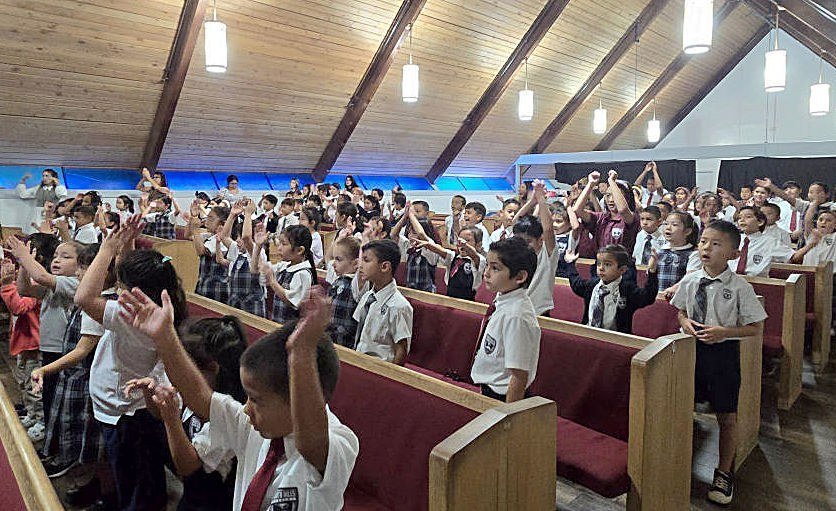
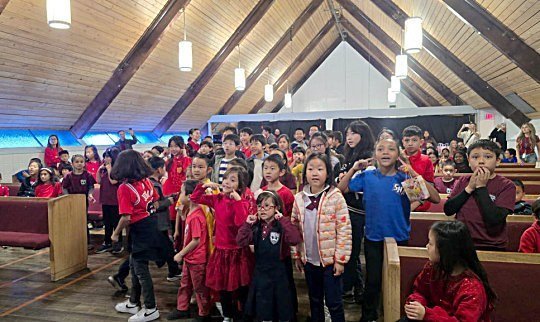
Once a week, students gather for chapel. If the word conjures a stern lecture, the reality will surprise you: there is singing, often loud, especially from the younger grades; a short talk built around a story students can use that week; and a few minutes of quiet. The talks are about things like telling the truth when it costs you something, what to do after you have hurt a friend, why one bad grade does not define you. Students take part rather than watch, and older students often help lead.
Chapel gives the whole school a shared vocabulary. When a teacher later says that was not honest, or a student says that was not kind, everyone from kindergartner to senior is drawing on the same well. You can read more about how faith is woven through the week on our spiritual life page.
Character Education Inside the Classroom, Not Beside It
The visible faith moments are easy to list: a short devotion or prayer to start the day, and Bible learning as part of the program; what that looks like at each grade level is on our Bible learning page. But most of the character formation happens in ordinary academic moments, because that is where character gets tested.
A student is caught copying homework. A group project falls apart because one child did nothing. Someone laughs at a wrong answer. In classes of 10–15 students, teachers see these moments, which is the practical difference a small school makes, and they treat them as teachable. The question is rarely only what did you do; it is who do you want to be, and what does making this right look like? Character education is a hundred small corrections in the moments that matter.
 Character education happens in everyday lessons
How We Handle Discipline
Families sometimes assume a Christian school means either harshness or leniency. We aim at neither. Our discipline works on a few principles:
- The rules are known in advance. Students are held to standards they have been taught; unwritten expectations do not count.
- Facts come first. When something happens, we establish what happened before deciding what it means. Students get to tell their side.
- Parents hear from us early. You will not discover a pattern of problems for the first time in a crisis meeting. If something is building, we call while it is still small.
- The goal is restoration. A consequence is a step in the process, and the process ends in a repaired relationship: an apology made and accepted, a habit changed, a student who walks back into class with a clean slate rather than a label.
Grace, in practice, does not mean no consequences. It means the consequence is never the last word about a child.
Serving Others Is Part of the Program
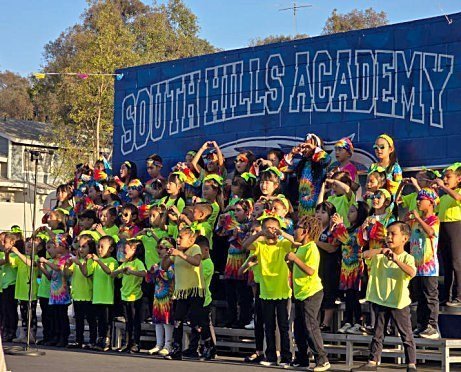
Service at SHA is not a photo op scheduled once a year. It shows up in small, recurring ways: older students helping younger ones with reading, classes taking on projects for people outside our walls, students learning that noticing a need and acting on it is a normal part of a week. Children become generous by practicing generosity, the same way they become readers by reading.
The Question Non-Christian Families Ask
The question, put directly: if we are not a Christian family, will our child be pressured to convert?
No. And we can tell you exactly where the line sits, because we hold it every day. Chapel and Bible learning are part of the shared school week; every student takes part in them, the way every student takes math. Your child will learn what the Bible says, sing alongside classmates, and be held to the school's standards of honesty and kindness. What your child will never experience is being singled out, graded on belief, or pressured to make a personal profession of faith. Faith cannot be coerced, and a school that tried would have misunderstood its own message.
Families from many backgrounds, Christian, Buddhist, non-religious, and more, choose SHA for what surrounds the faith: the safety, the moral seriousness, the adults who talk about right and wrong without embarrassment. Many tell us the values taught here are the ones they teach at home, under a different name. What we ask of every family is respect: a willingness for your child to participate in the shared life of the school. You can ask the same of us, and you will get it.

What It Adds Up To
Day to day, a Christian education here looks less like religion class and more like a thousand small consistencies: the same values in chapel on Wednesday and in the hallway on Thursday, teachers who know your child well, discipline that ends in repair, and a week with a rhythm built into it since 1957. If you want to know whether it fits your family, come stand in it for a morning.