Why Listening Matters: 148 Free Audiobooks Our Students Use
Practical guidance from the people who run the school — written to be useful whether or not you choose us.
A fact about children that surprises many parents: a child's ear runs years ahead of their eyes. A seven-year-old who struggles through simple sentences on the page can happily follow a rich, twisting story read aloud, and understand almost all of it. That gap between what a child can read and what a child can understand by listening is one of the biggest opportunities in language learning, and most families leave it untouched.
This is why we recorded read-along audio for 148 of the books on our reading list and put them online, free, on our learning resources page. Our students use them daily. This article explains why listening matters so much, for native English speakers and ESL learners alike, and how to fold it into a normal family week.
What Listening Does for Reading
Reading comprehension has a ceiling, and that ceiling is listening comprehension. A child cannot understand a sentence on the page that they could not understand spoken aloud. So everything that grows the ear grows the reader:
- Vocabulary arrives through the ear first. Children learn most new words from context, and audio delivers far more rich context per hour than a beginner can read on their own.
- Stories teach sentence shape. Hearing thousands of well-built sentences tunes a child's instinct for how English flows, which later shows up in their own reading, writing, and speaking.
- Narration models expression. A good reading voice shows where sentences breathe, how questions rise, how dialogue sounds. Children who hear fluent reading start reading fluently themselves.
For children learning English as a second language, the case is even stronger. English spelling is famously unfaithful to English sound; a learner who meets words only on paper often builds private, wrong pronunciations that are hard to undo. Hearing the word with the text in view welds sound to spelling from the start.
There is a knowledge dividend, too. Every story a child absorbs, about knights, whales, orphans, inventors, deposits background knowledge, and background knowledge is what makes the next text comprehensible. A child who has listened widely walks into a new book, or a new subject at school, already half-prepared.
Press Play, Follow the Light
The 148 audiobooks on our list are built for exactly this. Open any of them in a browser on a phone, tablet, or laptop, and press play. As the narration runs, the sentence being read lights up on the page, so the child's eyes and ears move through the story together. That highlight keeps attention anchored, links every spoken word to its printed form, and lets a child follow books slightly above their solo reading level without getting lost.
There is nothing to install, no account to create, and no fee. We built these for our own students and left them open to everyone. The books span the whole ladder of our 160-book leveled reading list, from picture books to classics, so there is a shelf that fits your child today and another waiting above it.
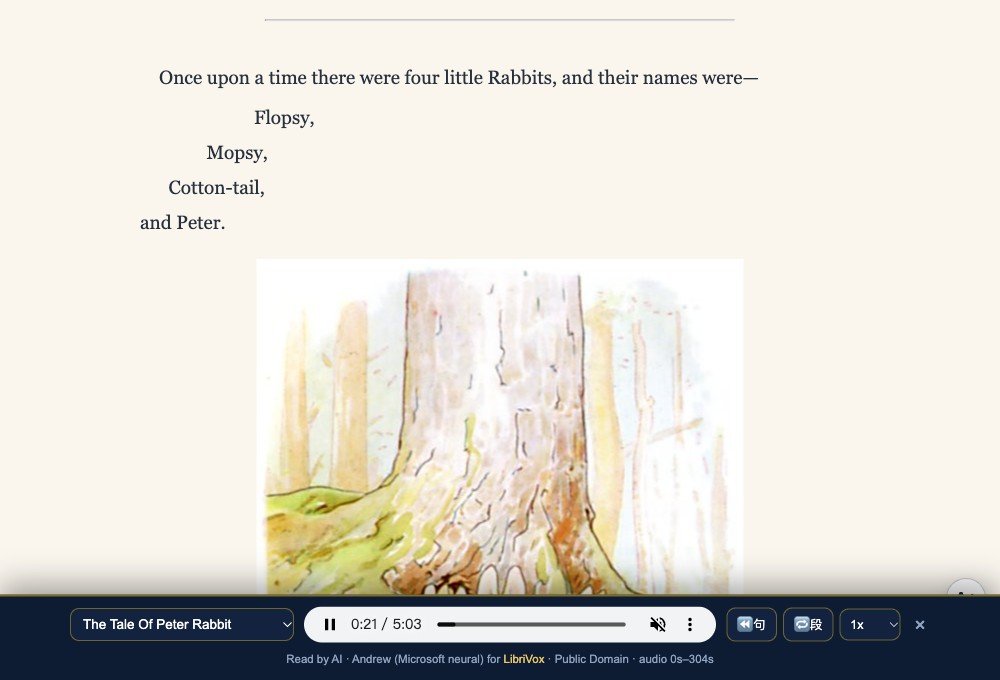 Open a book and press play: The Tale of Peter Rabbit, with the player bar at the bottom
Turning Dead Time into Listening Time
Listening fits into the corners of a day where a paper book cannot go:
- Bedtime. Trade one screen show for one chapter. A story in the dark is one of childhood's oldest pleasures, and it ends the day with language instead of noise.
- The car. School runs and weekend errands quietly add up to hours every week. A family that listens together also gets something rarer: a shared story to talk about.
- Quiet hands time. Drawing, building blocks, folding laundry. Hands busy, ears free.
A few habits make it stick. Keep sessions short and regular; fifteen minutes a day beats two hours on Sunday. Let your child choose the book, and let them re-listen to favorites as often as they like; repetition is how the language settles in. For ESL learners, a simple two-pass routine works well: listen with the highlight first, then read the same book alone. The second pass feels easy, and that feeling is what builds a reader's confidence.
Listening Is Half the System
Audio works best as part of a larger loop. The leveled list tells you which book fits; the audiobook carries the child through it; the bilingual editions catch the unknown words; and our vocabulary app makes sure those words are not forgotten. Each piece is free, and each is something our teachers use with classes of 10–15 students, where every child's progress is visible.
If you would like to see how this looks in a real school day, come visit. We will happily show you.